Save vs. Spell
50 min read
Planted: 2 weeks ago
Last tended to: 1 week ago
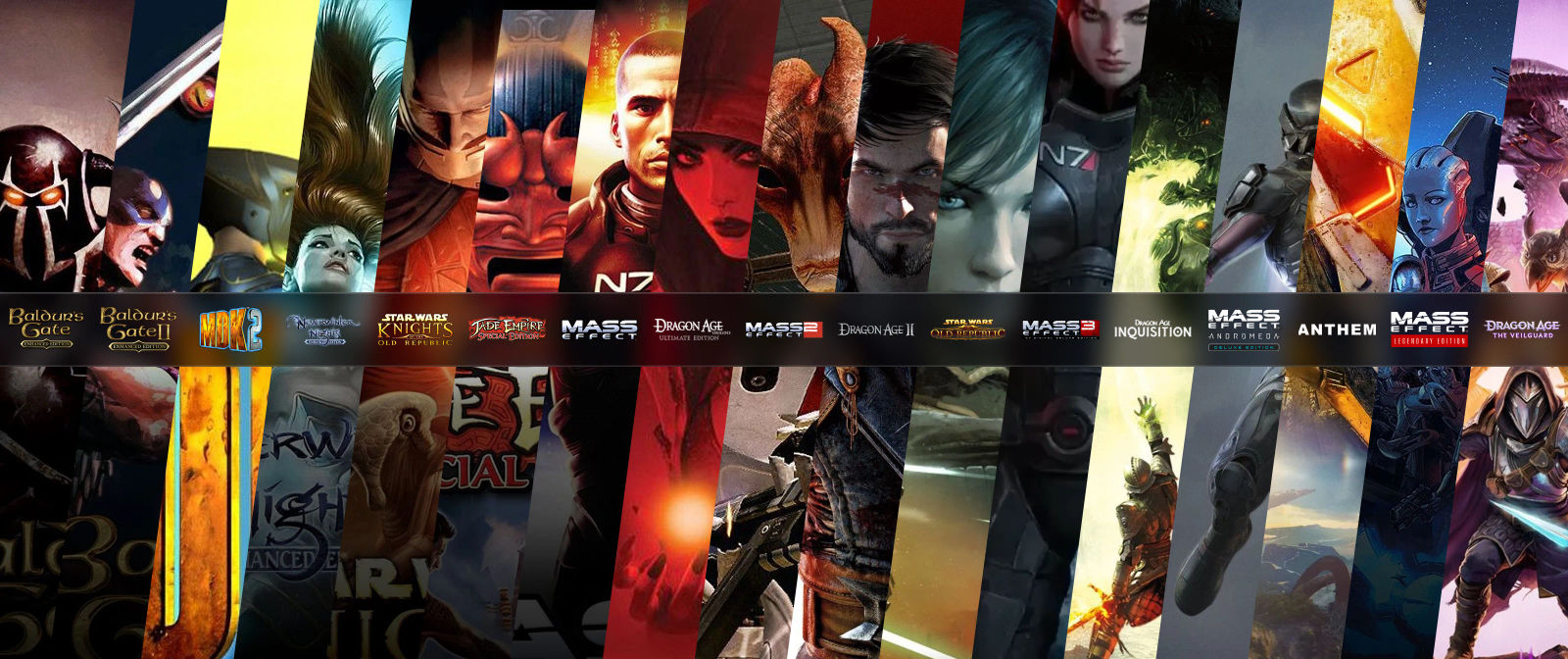
Image Credit: Steam store assets, with Female Shepard from the Mass Effect fan wiki and Anthem’s key art from the Anthem fan wiki, arranged by me. Everything in it belongs to its owners.
BioWare was closed on a Wednesday.
I was going to write an ode. I had the bones of it, a disc from 2000 I couldn’t beat, a galaxy I got through a bad year in, a collector’s edition I played for three days straight. Then Electronic Arts closed the studio, the Edmonton office went with it, and early work on the next Mass Effect ended, and an ode to something alive was the wrong thing to write.
So here is what I would have said. For thirty years BioWare made the games that left a chair out for me. I don’t mean a character who looked like me, though I’ll get to the hair. I mean a room with room in it, where the party talked to me when I walked in, a writer answered on the forum, and the story left a space the exact size of whoever was sitting there. I kept coming back for the chair.
Two Discs
The first chair was at a desk. My parents got another computer in 2000.
A large beige mass arrived, with a monitor of astonishing depth, speakers that mounted on the side and the usual keyboard + mouse combo. It also came bundled with two games, which I had no idea was a thing. I didn’t know either name.
One was Sid Meier’s Alpha Centauri, which isn’t BioWare’s, though I’d be cheating to let you think a house like this had only one parent. It was a game about leaving. Humanity’s colony ship arrives on a new planet, the leadership has been murdered in transit, and the passengers fracture into seven ideologies that all, to be fair to them, have a point. I play it at least once a year. It is, I think, the reason I like stories in which people are put in a new place and asked, politely, to disagree.
The other disc was Baldur’s Gate.
I’m told, by the internet, which knows, that the original shipped on five CDs. Mine, in my memory, is one disc, DVD-ROM, a small silver coaster with a very large game on it. Memory compresses. Or the bundle did. Either way, it’s the only version of the thing I can see when I close my eyes.
I had never rolled a twenty-sided die. I did not know that the game I was looking at was a patient translation of a paper ruleset from the seventies. Nobody had told me what a Dungeons & Dragons was. I understood Dungeons and I understood Dragons, and the conjunction seemed, on its face, redundant.
The game opened, and some very patient person had decided that the correct amount of introduction was a little. A voice told me about a keep called Candlekeep, a foster father named Gorion, and a feeling in the air that something would soon be wrong with the world. I walked a short distance in a direction. Gorion, who had raised me and who represented the entire emotional weight of the first act, was killed within minutes of leaving home by a stranger in armour.
I was ten minutes in. I had barely learned to click.
Baldur’s Gate is the game that taught me the word party, the small group of people you have, deliberately and under duress, put in a row. I picked up an elf, then a man who spoke exclusively about his hamster, then a girl who seemed to be my childhood friend and who I would not leave alone for any amount of money. I did not know that any of this was a design. I thought I’d stumbled into a very weird combination of people.
And I lost. A lot. I got my ass kicked in the muddy first hours by gibberlings, which sounds like a thing you’d feed a toddler, and by bandits, whom I had presumed to be background colour.
The ruleset was an opaque grid of numbers. I was shown THAC0, which stood for To Hit Armour Class Zero, and which I read as a sort of sneeze. Armour class was better when it was lower, so I’d put the best armour I could find on my best fighter and watch the number go up, and wonder what had been done to me. I learned, slowly, to pause the game with the spacebar, which I now think is the kindest idea in the history of the genre. Time stops. You can think, and tell your six characters, one at a time, what you hope they’ll do, and then let time start again and watch everything go precisely wrong.
And there was a line on every character sheet that I came to dread. Save vs. Spell.
In the version of D&D that Baldur’s Gate implemented, when something happened to you that you did not want, a spell, a poison, a gaze, a breath of fire, the game would roll a die on your behalf, and if the number came in at or above your saving throw, you avoided the worst of it. There were several kinds, with names like Save vs. Death and Save vs. Breath, and last, Save vs. Spell.
In a game that is mostly about spells, it was the one that was always on. It was the roll the game made for you the instant before something horrible. You didn’t press anything. You didn’t do anything. The game showed a little line of text, and the text said you’d failed, and you were a frog.
I hated it. Save vs. Spell. A tiny, bureaucratic phrase that stood for the whole condition of being a person who needs to be rescued from something by luck.
I kept the disc anyway.
The 1998 trailer. The graphics look like a postcard from a country that no longer exists, and I’d cross a border for it.
Here is a thing I didn’t know at the time: BioWare was founded by three doctors.
Not doctors of philosophy. Doctors. Ray Muzyka, Greg Zeschuk and Augustine Yip had all just finished medical school at the University of Alberta, and instead of going into hospitals they started a software company in 1995, putting in a hundred thousand dollars each and working in a small room in Greg’s basement. They called it BioWare, a word that joins biology to software, and the line they said about it was that they wanted to make software for humans.
It’s a funny sentence to have been taken so literally. These three had spent years in anatomy labs and emergency rooms, and when they said software for humans they meant something closer to bedside manner.
I think that’s what I felt in the swamp, being slaughtered by gibberlings as a kid. I wasn’t enjoying the combat, or, to be honest, most of the mechanics, but there was a feeling underneath it of being addressed, of someone on the other side of the screen who wanted me to be okay and had made a very specific kind of world to leave me in for a while.
I didn’t know to call it care. I knew only that I wanted to go back.
To a Galaxy Far Away
I did go back. Baldur’s Gate II came out in 2000 and is, by about every account I trust, the high-water mark of the whole style of game. Neverwinter Nights came in 2002 and gave a generation of people a toolset and a reason to stay up. I never played it, so I’m skipping it.
The one I did play was Star Wars: Knights of the Old Republic, which came out on the original Xbox in July 2003 (though I played it on PC a year later), made by BioWare with LucasArts. It did the thing the films have found strangely difficult. It stepped away from the Skywalkers and went back four thousand years, to a time when the Jedi were a bureaucracy with a few cracks in it.
I was, I think, already primed. Baldur’s Gate had shown me that a game could be about a group of people. KOTOR showed me that a group of people could be about you.
Here’s how the first hours went, the way I remember them rather than the way a wiki would. You wake up on a ship that is being shot at. A soldier named Carth, who has the face of a man recently disappointed by a government, tells you to run. You crash on a city planet called Taris, a lasagne of apartments and bounty hunters, and you pick up Bastila (a Jedi), Zaalbar, Canderous, Mission, Juhani, Jolee and a droid named T3.
And you pick up HK-47.
I can’t write about KOTOR without the assassin droid. HK-47 is a murderous, extremely polite robot who calls humans “meatbags,” addresses you as “Master,” and is one of the funniest characters ever put in a video game. The comedy is structural, a creature whose ethics are entirely about killing and whose manners are an old-fashioned butler’s.
Because of him, I think, I started noticing that BioWare’s companions were not extra swords. Each was a position in an argument the game was having with itself. Carth was the believer who’d had his belief broken. Bastila was the believer who couldn’t tolerate that it could be. HK was the question of what a purpose is, if the purpose is only to be used. Every few hours you’d be placed in front of one of them with dialogue options and time to spare, and without noticing you’d begin to take a side.
And then there’s the twist.
I won’t spoil it, because someone reading this is about to play it, and I envy them. The game had been quietly building a question for the first third of its length, who are you?, and when it answered, the answer rearranged every conversation I’d had up to that point. I think I actually stood up. In a room where I was alone, I said a word out loud.
A good twist isn’t about surprise. It’s about the second reading. I’ve been chasing that feeling ever since, with my own sentences, with mixed results.
The 2003 trailer. Notice that the music is already sure of itself, in the way music is when it knows something you don’t.
The sequel was made by Obsidian Entertainment, a studio of former Black Isle people who’d been given about a year and a half to build a game on someone else’s engine. It shipped in December 2004 with some of its content cut, much of it restored by fans since. I love it more than the first. It is a stranger, nastier, more honest game, a story about the cost of being the person everyone else hangs their hope on.
They made a form, and other people, in other buildings, learned the grammar and wrote things I loved even more.
The next one was Jade Empire, and it’s a little more complicated than “this game was great.”
It came out in 2005, an Xbox exclusive from Microsoft, and it was BioWare’s first wholly original world. (I played it on PC two years later.) No licence, no Forgotten Realms, no Star Wars. A mythical China, in a game explicitly in love with Hong Kong action cinema. The combat was real-time, and you could switch between fighting styles mid-fight, some martial, some magic and some a kind of weaponised gesture.
I loved it, and I love martial arts. The fights took the choreography of the films I’d grown up watching, the way a body can seem to hang in the air a second longer than physics allows, and put it under my thumbs. For the first time, I could be in the shot.
And there was a style, among the many, whose name I’d say aloud. Thousand cuts. I would say it in the kitchen. I would say it at a printer. I would say it while I learned how to cook.
But the China of Jade Empire was built out of films, and out of other people’s idea of films. It was a loving imitation, not a portrait. I knew it even then, and loved it anyway.
The Jade Empire cinema trailer, IGN’s upload.
A Place to Be
Now, let me tell you about the dumbest thing I’ve ever bought.
Mass Effect came out in November 2007, first on the Xbox 360. It was the project of Casey Hudson, who had directed KOTOR and Jade Empire, with Drew Karpyshyn writing and a studio that had been bought by Electronic Arts a month earlier. I didn’t know about the buying then. What I knew was that the game was about space, and the people who’d made the game I’d loved most had made it.
I walked into a shop and I bought a copy of a game for a machine that was not in my house. I carried it home, put it on a shelf and looked at it from the bed. It was the cover, a figure in armour against a galaxy, and it sat in my room the way a postcard sits on a fridge, from a place I could not enter, sent by someone who’d obviously had a nice time.
There was a plan, of course. The plan was that I’d get the machine. The plan was that this was a down payment on the future. The plan evaporated and the disc stayed, and so did the shelf, and so did the feeling. Eventually the game came to the PC, and I bought it again.
I own it twice. One copy waited a long time to be played, and I wouldn’t part with either.
I got this game at a bad time. I’m not going to say why; it isn’t that kind of piece. There were weeks when the main accomplishment of the day was that it had happened. The Normandy was a place to be. I’d walk the deck and a person would be reading in a corner, another would be figuring out the galaxy map, and another would stand at a console in a posture of such exquisite social unease that I wanted to bring her tea. They talked to me when I came near. They were scripts, and the scripts were better than the weather in my head. I wasn’t alone in there.
You are Commander Shepard, a soldier in the human Alliance in 2183, picked almost by accident to be the first human in an elite order of agents who answer to a council of alien species. A rogue agent of that council has found something very old and very bad, a machine intelligence that harvests all organised life every fifty thousand years. The stakes of a thousand paperback covers.
There was a turian, Garrus, a cop who’d decided the rules weren’t getting him the right outcome. A quarian, Tali, on a pilgrimage in a suit she couldn’t take off without risking infection, so that every emotion travelled through the posture of a helmeted woman. A krogan, Wrex, large and bleak and unsure anyone deserved saving. And Liara, Ashley and Kaidan.
None of them is the hero. YOU are, a Shepard who can be anyone, and the game spends forty hours making clear that what a hero is for, in a story about a galaxy, is to be a person other people can say yes to. The crew says yes, or no, or not yet.
You can fail, and the sequels make sure you can. On Virmire you’re told to leave one of two people behind to die. Whichever you chose, you carry it through the rest of the game, the next one and the one after, talking to the survivor and watching their face.
In a time when I couldn’t carry much, it handed me one weighty thing and said, see if you can hold this.
The Mass Effect E3 2006 trailer. This is what I was missing for a year.
Adopted
Two years later BioWare handed me another world. Dragon Age: Origins came out in November 2009, and I picked it up on release day, for a piece of armour.
My cousin, who was there for the purchase, made two jokes about it that day, and the second was the more accurate. I’d bought a game for its armour, and the game was the free gift. EA had bought the studio two years earlier, and somebody there had decided a new copy should come with an object. The object was a code for a set of armour called the Blood Dragon, dragonscale-red, with the confidence of a heavy metal album cover. It worked in Origins and in Mass Effect 2, a game that hadn’t come out yet. I didn’t need it in either. I wanted it in both.
So I bought a fantasy game, from a studio I trusted, in a genre I didn’t exactly love, because there was an object on offer. My cousin was right. The first joke came sooner, in the first hour, once I’d built my character and was looking at the family the game had issued them. I’d made a Black character (as I remember it, the palette of skin tones didn’t go much past sunburned; my memory may be unkind) Then the story began and handed me a mother and a father, or the equivalent, who were on screen extremely pale.
My cousin looked up from over my shoulder, and then at me, and then at the screen, and then at me.
So you’re Black, and your parents are white. Were you adopted?
We laughed so hard I had to pause the game. I said yes, I was adopted, and I played the rest of it that way.
It was a bit that turned into a method. My Grey Warden had been taken in. They’d grown up knowing, in the quiet way you know such things, that their place in the family was given rather than assumed. When the story asked for loyalty to the people who raised them, I played it with a slightly clenched jaw. When it said the kingdom was coming apart, I played it like the collapse of a house that belongs to someone who was kind to you.
Nobody else would have noticed. But because it was a BioWare game, it let that be real. Nothing in the dialogue contradicted me. The writing was loose enough, generous enough with its silences, that a Warden of any background could slip inside it and find a shape.
That’s the lesson I lean on most. The best writing in these games was loose in the right places. It told you what the world had done, then paused, politely, so the person on the other side of the screen had room to be someone. I try to leave a door open at the height of a person I haven’t met.
For the unfamiliar, Origins was set in Ferelden, a damp, stubborn kingdom about to be overrun by darkspawn. You were a recruit of the Grey Wardens, an ancient order whose job was to end such invasions. In the first battle the king’s army is betrayed by its commander, and you wake up as, more or less, the last of your order who isn’t dead.
It was a spiritual successor to Baldur’s Gate, with a pausable tactical view, a party of four, and a long list of statistics I was this time equipped for. (I knew which number I wanted larger.)
I’m not a fantasy fan, as I’ve said. The genre’s comfort is an invented world where moral questions are simple, and Origins used the same vocabulary to make them as hard as they are in the real world. It was a science-fiction story in a fantasy skin.
As usual, the party was what stayed.
There was Alistair, a Grey Warden conscripted young, who handled the trauma with a joke every few minutes, so that when he stopped joking you felt the temperature of the room change. There was Morrigan, a witch from the swamp who looked at civilisation the way a doctor looks at a rash. Leliana, a bard with a secretive past. Sten, a warrior of a species that does not understand yours. There was a dog. I’ll say nothing more about the dog except that you should get the dog.
Underneath was a system that seemed, for the first time, like a design. Each companion had an approval rating. Gifts and choices that took their side raised it; something they found unforgivable lowered it; low enough, they left, or fought you, or both. The question was never only what do I want to do? but what will it cost me with the people who follow me?
I miss that fear most. A plot where the stakes are the end of the world and also whether the person beside you puts down their sword and walks into the forest because of something that only seemed necessary to you. You couldn’t treat the companions as a resource. They were people, in the sense that people are what you can’t optimise.
The live-action Sacred Ashes trailer, a very good short film in its own right.
I spent a lot of that winter on the forums. There was the BioWare Social Network, a message board on the studio’s own site, with regulars and threads running to thousands of posts where strangers argued class builds, companion romances, whether a decision in a game had been right. There was fanfiction, and a moderator who’d quietly un-break things if you broke them.
And the people who made the game posted. Writers and designers turned up. I remember being no one, typing a question into a box, and getting a reply from someone who’d had a hand in the thing, in a tone of faintly embarrassed good humour, as if caught in the work clothes of a different job. It made the studio a place with a front door, where you could knock.
As the games grew more ambitious about the characters they let you love, the forums developed a politics. I remember a player complaining that the romances weren’t designed for the player he considered the default, a straight man, and a reply from a writer. The reply, as I remember it, was that those games had never been for that player alone. The argument was huge and ugly.
I made my own Warden in Origins because the game didn’t contain many people who looked like me, and gave them an adopted family, first as a joke and then as a solution. In The Veilguard, fifteen years later, I spent an hour in the character creator delighted by the hair, as I said in my review. The afro textures alone!
What I think the studio understood, at its best, is that specificity isn’t exclusion. You could write a romance for a particular person without taking the story from anyone else. A game could offer a gay mage from Tevinter who was a person first, and a transgender soldier mentioned in passing without a lecture, and it didn’t make the game worse. It made it more like the world.
The record isn’t clean. Things in the older games, and some in the newer, aged badly or were wrong at the time. I came to the studio slightly at the edge of every room, and for a good while it felt like a place that had set out a chair for me. I didn’t ask. They set it out because it was a good idea.
Years later, when the games started to disappoint, I remembered this. Part of why I forgave them is that I thought of them as neighbours. You’re a different kind of customer when you think the people behind the product know your name.
No Empty Chairs
That winter ended with Mass Effect 2, which came out in late January 2010, and I bought the collector’s edition, because by then it was clear to everyone around me that this was how I’d decided to live.
I had three days before university classes started again. I didn’t plan a schedule; the plan formed itself the moment I pressed new game.
I finished everything. Every loyalty mission, every side quest, every scan of every planet, a mechanical tedium its completionists, me among them, treated as a form of prayer. Every conversation I could reach, every upgrade for the Normandy. I slept as little as a person can and remain one. At the end of the third night, with the window the colour of dishwater, I walked into the last mission, which the game had been calling a suicide mission for forty hours, and came out with every single person alive.
No one died.
The last hour works like this. You fly through a relay no ship has come back from, to a base at the centre of the galaxy. Your crew has to do specific jobs in specific places. Someone has to hack a door, someone carry a barrier, someone escort the injured. Give a job to the wrong person and they die. Skip the ship upgrades and someone dies before you reach the base. Forty hours of conversations and favours for people with haunted looks turn out to have been an exam, and nobody told you it would count.
It’s an argument about leadership, made of the small acts of care that make I trust you with this possible, not the speech at the gate. And the game is cruel enough to include the corollary. You can do everything right and still lose someone, or do it all wrong and have a lucky day.
When I walked out with no empty chairs I made a noise I won’t describe.
The Collectors, the insectoid abductors on the cover, were underwhelming, and the thing the whole story had been walking toward was a boss fight. I didn’t mind. A game like this is a long hallway, and the room at the end can disappoint if the hallway was full of faces. Mordin, a scientist who talked faster than he thought and spent the rest of his life trying to be worthy of forgiveness. Garrus, scarred and furious. Thane, an assassin who rehearsed his memories like messages for someone he no longer expected to see. Legion, a machine whose question had the whole room leaning forward. People I met on the way to dying, who didn’t, because I paid attention.
I went to class on the fourth day like someone who’d come back from a funeral and found out it was a surprise party.
The Mass Effect 2 launch trailer. I watched it more times than I’ll admit.
A year later came Dragon Age II, in March 2011.
It was made fast, in about sixteen months, and you could tell. The dungeons were reused so often they became a repertoire, the same cave flipped with a different door. People were angry, and I understand it, because you could see the better game through it.
It was personal, which is why I liked it. Dragon Age II was about a family that fled a war and ended up in a city on a hill, and what the city did to them over about a decade. You were Hawke, a refugee who becomes someone of consequence through a long run of unrelated errands for people with unrelated problems, whose sum is somehow a legend.
The story is also being told to someone. Varric, a dwarf, rogue and liar and very good friend, is being interrogated by a Seeker of the Chantry about where Hawke is, and he exaggerates, misremembers, gives himself a better line than he had. She interrupts to say he’s lying, he concedes, and the game rewinds and plays the scene again, truer. An unreliable narrator you can interrupt.
In 2011 a lot of it went over my head. It took me years, and a long stretch of writing my own fiction, to see that the game had done something clever and brave.
The mage and templar plot, a side argument in a tower in the first game, grew teeth. Kirkwall was a pressure cooker of what happens when two sets of well-meaning people are each given half a justification. There was no villain, only a situation, and you could feel it tightening in the quiet of the loading screens.
Dragon Age II, the extended trailer (IGN’s upload). The one I defend at parties.
That December came Star Wars: The Old Republic, three months before the third Mass Effect, made by BioWare Austin and reportedly the most expensive game ever made up to that point.
I only played it once it went free-to-play, in November 2012, and only for a bit. It wasn’t for me. A BioWare game works because the story is about you, and an online world fills up with other people who are also the hero, running past your big moment on the way to theirs.
The trailers were another matter. Blur Studio made a run of cinematics for it, and Deceived, the sack of the Jedi Temple, is the one I loved. I enjoyed it more than the game, and I don’t think that’s a criticism of either.
Deceived, by Blur Studio.
Marauder Shields
The third Mass Effect was the one I’d been waiting for, and I took it seriously. I consumed every trailer, interview, developer diary, comic and novel. Take Earth Back aired during an episode of The Walking Dead in February 2012, and I watched it like a letter from the front. Somewhere along the way I read Geoff Keighley’s Final Hours account of the making of the game, which included a multiplayer shooter started and cancelled in Montreal.
My girlfriend at the time gave me the digital collector’s edition for my birthday. I hadn’t asked. She’d paid attention, which is rarer than money. It was one of the kindest things anyone has done for me.
EA’s launcher, Origin, let you pre-load a game and unlock it at midnight on release day. There was a way to unlock it early, which was to change the clock on your computer. You tell the machine midnight has arrived and the machine, which believes anything, agrees. I changed the clock. I’d like to say I hesitated. The date turned and the game opened a few hours early, as though the future had been a door the whole time. I have never felt so clever, or so briefly. The first hours were what I’d hoped for. The war had started. The machines I’d been warned about since a dead beacon in the first game were over Earth. I played the opening level like walking into a church in a country where you don’t speak the language. There’s a child in it. I played it more than the others, because of the multiplayer, which I generally avoid. It was a co-operative mode, four players against waves of enemies, which nobody had asked for and which the Montreal team had bolted onto a single-player RPG. It should not have been good. You’d be in a match with three strangers you never heard speak and cover each other without being asked. It fed back into the main game as a measure of the galaxy’s readiness for war, so after closing the campaign for the night I could go and win points for Shepard. No other role-playing game I’d played had after-hours.
The game was mostly magnificent. Two or three hours of it are the best of the series and maybe of the studio. A planet of armoured lizards decides whether to forgive what was done to them. A scientist who talks too fast and a commander who can’t stop listening have a conversation at the top of a tower. The companions talked to each other in the dark like friends who knew the end was close.
Then the last two hours happened.
It’s been fourteen years. It felt like being a guest at a wedding when the speeches turn out to be about someone else.
You reach the end of a long road of three games, a hundred or two hundred hours, and a hundred decisions you’d been told would matter. Whether you saved the council, cured a plague, trusted a machine. You’ve built an army and watched people die for your plan. At the top of the Citadel a glowing child appears (oh, that child), explains what the Reapers are for, and offers three doors.
Red, blue, green. Whatever you did, whoever you saved, you get the same three doors and the same cutscene, tinted. Then the Mass Relays, the network that made the galaxy a community, are destroyed, the Normandy crashes onto a green planet, two people you may or may not care about climb out of the wreck, and a very old man tells a child a story about a hero called Shepard.
I was furious, with the heat of a person betrayed by a friend in the politest possible way. I sat in the chair without moving. I think I turned the machine off, then on again, and redid the last ten minutes, as though a different sequence of clicks might let me out of the house.
Shepard dying was fine. What got me was the contract. Three games had taught me that my choices mattered, and at the one place it was supposed to be paid, the game gave me three doors. A story makes promises, some out loud and some silently, and readers forgive a lot, but not being told the promise was never meant. Every time I write a last line I ask what I told them early, in a low voice, that they’ll be waiting for.
I was one of many. A group of players started Retake Mass Effect, which raised more than eighty thousand dollars for a children’s hospital charity in a few days and confused the charity so much that it asked them to wind it down. Others built the indoctrination theory, that the whole sequence was a Reaper hallucination, which was persuasive and also a kind of grief, because if the ending was bad on purpose then it wasn’t a failure, it was a puzzle. And some people did things to the staff that I’m ashamed to share a fanbase with.
BioWare listened. A little over a month after launch it announced a free Extended Cut, out in late June, which added a long, warm epilogue and explained more about the relays. It didn’t change the three doors. Casey Hudson said on a BioWare podcast that some people had rejected the idea of the ending altogether and wanted the studio to start over, and that this wasn’t something they could do. It was the most honest thing anyone from the studio said that year.
I’ve since read, in a retrospective for the studio’s thirtieth anniversary, that the ending was reworked after a stretch of severe crunch that burned the staff out. That should make me less angry. It makes me sad in a different part of the body. The ending I hated was made by people who gave everything and then a bit more.
I didn’t play the Citadel DLC then. It came out a year later, and everyone whose taste I trust calls it a love letter. I could feel the exact shape of what I wanted, a click away. I didn’t click.
I didn’t touch the game again for nine years. I’d have cried at that DLC, and I couldn’t be that person. Part of me stayed in the chair, finger hovering, waiting to be told the contract had been honoured.
My anger was justified, and also a way of saying I loved them more than they could bear. I was right to leave and wrong to stay gone.
Take Earth Back, the cinematic. A perfect trailer for the first twenty hours of the game, which is where I’d like to have stopped.
I did go back, in the end. On 7 November 2020, N7 Day, the studio announced it would remaster the whole trilogy. N7 is the designation of Shepard’s elite training, and the date became a kind of secular holiday, when the studio posted a trailer, a gift or a wink every year.
Mass Effect: Legendary Edition came out in May 2021, with the three games improved, in one box, and nearly all the DLC.
I played it in a household of one, a small apartment. It wasn’t a lonely time, because I had a best friend who also plays games, loves science fiction and is an artist, and who took the announcement as a call to arms. She decked my tiny apartment in Mass Effect things, with art on the walls, small objects on small shelves and something on the door. She sat down to play with me and fell asleep five minutes into the game. She didn’t get the fuss, and was kind about it.
She tried again years later and got hooked. It’s one of my favourite things that has happened to me. I watched someone fall for a thing from a great distance and then, one night, all the way. She played the first game and the second and had opinions, good and mean. There’s a running gag about the Illusive Man, the smooth, cigarette-smoking head of a human organisation who funds the second game and has, to be fair, a lovely voice. Somewhere in the middle she skipped some dialogue, and for a long period she believed he was a nice guy, a kind, concerned, rather lonely old gent unfairly treated by the press. I have corrected her many times. It hasn’t taken!
I finally played the DLC, all of it. Citadel is as good as everyone said, the party and the farewell, and I loved it. Omega, not so much.
The Legendary Edition reveal. Watch for the first appearance of the Normandy and forgive whatever your face does.
The Doctors Leave
The founders left within five years of selling the studio, and I was too busy nursing a grievance to notice.
In 2005, BioWare and Pandemic Studios were bought by a private equity firm, Elevation Partners, and put into a holding company. In October 2007, Electronic Arts bought the holding company for about three-quarters of a billion dollars. Mass Effect came out the next month with BioWare’s name on the box and EA’s in the small print. Some call the sale the death of the studio and some call it a lifeline. It was a bargain with two prices, collected at different times.
Greg Zeschuk said in a podcast interview in early 2025 that the sale wasn’t the catastrophe fans make it, since the studio had a good run afterward. But by the end of the second year he knew it wasn’t a good fit for him. He called Star Wars: The Old Republic his swansong, and said he’d known it was a one-way trip.
On 18 September 2012, six months after the third game, Zeschuk and Ray Muzyka announced their retirement, from the studio and from the industry. Ray would turn to philanthropy. Greg would make beer.
I picture the day two doctors who had started a company in a basement and built it into a house handed over the keys. There must have been relief in it too, after seventeen years of caring for something. I hope the beer is good.
After that it’s a list. Casey Hudson, who directed KOTOR, Jade Empire and the whole Mass Effect trilogy, left in May 2014. David Gaider, who’d written the soul of Dragon Age and been the studio’s voice on the forums, left in January 2016. Mike Laidlaw, who’d directed the Dragon Age games from the second to the third, left in October 2017. James Ohlen, who’d been designing BioWare games since Baldur’s Gate, left in the summer of 2018. The people were a chorus, each knowing a few bars of a song. When one left you still heard the song. When two left it was still recognisable. When the sixth and seventh left, the song could still be sung perfectly in tune, and it wouldn’t be the song.
Within a month of the remaster announcement, on 3 December 2020, Casey Hudson and Mark Darrah, who between them had run the Mass Effect and Dragon Age lines for most of two decades, said they were leaving (for the second time). The studio was putting its past on a shelf and polishing it while the people who made it put on their coats. A teaser for the next Mass Effect appeared that same month, and I felt, like most fans, an enormous, gullible joy.
The Bog, and the Lights Left On
Meanwhile I’d gone back to Thedas. Dragon Age: Inquisition came out in November 2014, and I played it every day for months. Take every literally. That winter, and on into the summer, I woke, did what I had to do and went home to Skyhold, a mountain fortress full of people who’d decided to believe in me. I was the Inquisitor. I had a war table with a map on it, a throne I didn’t use because I felt silly, a garden I used a lot because the companions turned up in it, and a balcony where a certain elf stood looking at a certain sky.
It was the biggest game the studio ever made and the most generous. You could wander the Hinterlands for a week and not run out of requests. People wanted wool. People wanted their husbands found. A rift in the sky had been dropping demons on the countryside, and you closed them one by one with a hand given to you for the purpose, and a villager looked at you as though you were a bridge.
The companions were the draw again. A Seeker who’d done the interrogating in the last game and was learning to give orders gently, Varric again, a mage from the Orlesian court in tall hats, a mercenary with horns, a qunari who treated every conversation as a negotiation he meant to win honestly, and a ghost in a young man’s body with no idea what a person was supposed to feel. And there was the elf on the balcony, whose reveal at the midpoint was one of the finest turns the series managed.
It won Game of the Year at The Game Awards that December. Going back years later, the busy work that had been invisible while I was in love with it showed. A hundred hours turned out, in places, to be a very pretty checklist, like discovering a house I loved was mostly hallway. I don’t regret the hours. I’d go back, for the people.
The Fallow Mire is a stretch of marsh under a wet-wool sky, and it was the first place my computer couldn’t cope. Fog, water, reflections, animation on everything. The frame rate gave up on me personally, and the game stuttered like someone trying to say a hard word. My method was to look at the floor. I turned the camera down to the mud under my boots, where there was less to draw, pressed forward and walked across the swamp. I would swivel the camera up momentarily and also check my map. I did this for hours. It was a deeply stupid way to play a game designed by hundreds of people for the view.
Then I got a GeForce GTX 970. I use the word love without irony. I walked into the mire again, the fog came in over the water, the light lay on the surface like a pale coin, and it ran beautifully. I stopped in the middle of the path and looked up at a heavy, grey, handsome sky for the first time. I loved it through that period’s news that its memory was divided in a way that hadn’t been properly disclosed, a half-gigabyte asterisk that made people cross. I didn’t care. It had shown me the sky.
Inquisition, “The Breach.” This is the sky I wasn’t seeing.
Mass Effect: Andromeda came three years later.
It was announced at E3 in 2015, and I was ready to be first through the door. A new galaxy, a new crew, a place where nothing had been mapped. A trilogy’s worth of canon put down like a coat. I thought it was brave. I still do.
The reviews came in March 2017 and weren’t good. The faces were stiff, the animation lacked the suppleness of the first trilogy, and there was a sense of a vast thing built by people who hadn’t had time to smooth it. Sales were below hopes, and by the end of the summer the Montreal studio that built it was demoted.
I was a broke postgraduate student and didn’t buy it. When I got a PlayStation 4, I finally played it.
It was fine. Parts were lovely, like landing on a planet with the music coming up and a vehicle under you again, the frontier feeling, and the misfits on the ship learning to get along. The combat was the best the series had, fast, jumping, sliding, and I’d have played it forever.
But BioWare had never been a studio that was fine. It was the studio that made me look up from the screen with my mouth open and annoy people by talking about it. Andromeda didn’t do that to me.
What I mostly felt was the loss of what I’d been promised, which was downloadable chapters, a sequel and answers. Within months the plans were folded and the updates ended, the house left with the lights on and nobody home.
The Magic Had a Price
Then came Anthem, which I never played. I’m a solo player, and a game that asks me to find three strangers and a schedule has politely declined to be for me. The game was revealed in June 2017 at an EA showcase. The demo was spectacular, players flying over a jungle and through a waterfall, and it rested, as later reporting showed, on something so fragile that not a single mission was finished. The studio had been handed an engine it hadn’t chosen, a genre it hadn’t tried, and a short time. The genre was live service, a game designed not to end but to be returned to, week after week, which the publisher had come to love.
It shipped in February 2019. Two months later Jason Schreier, then at Kotaku, published an account based on nineteen people who’d worked on it. The game hadn’t really entered production until the last eighteen months. EA’s Frostbite engine, which the studio was required to use, was ill-suited to a role-playing game, and the engineers who knew it were pulled away to work on American football. Leadership was indecisive, and people across the project suffered anxiety, depression and months of stress leave.
The report used a phrase that stayed with me, BioWare magic. Staff used it for a long-standing theory of how their games got made. Each looks like a mess for years, and in the last stretch it somehow comes together. I’d used the phrase in a review, with a question mark, as a joke. I had no idea it described, from the inside, a sustained cost to the people who made it. The magic was labour, and every game I loved, my three days in 2010 included, had a price paid by someone who’d stopped going home.
I don’t know how to love something made like that. I know that I did, that the games were extraordinary, and that the thing I loved may have cost people their health.
For years afterwards the studio went quiet. I’d check in the way you check on a relative, and find a blog post and a hiring notice. It was sad to watch the studio pulled toward live service. A publisher sees a game people play for years as a clock that never stops running, and a studio that makes games you finish looks like a shop with a closing time. The one I kept an eye on was Dragon Age, whose news came in spurts. A teaser at a ceremony in 2018 under a subtitle saying the Dread Wolf was rising; a confirmed title in 2022, Dreadwolf; then in 2024 a quieter, stranger change to The Veilguard. Three names for one game.
After Inquisition, according to later reporting, the studio began a smaller, more intimate Dragon Age. It was cancelled in the years when the publisher wanted everything to be live service, and the next version was built around ongoing online play. Then, after what happened to Anthem, the project turned around again in early 2021 and was rebuilt as a single-player story. In August 2023 about fifty developers were let go, many from the very game about to be finished. It was retooled again, smaller.
It came out on 31 October 2024. I’ve already written about it in my review, so what follows is what I left out.
I said it was fine, handsome and polished and much safer than the games that made the name. The dialogue was a bit too nice and the stakes a bit soft; Rook, the hero, couldn’t be rude enough to start a fight; Thedas, a world about racism and religion and who gets to hold power, had become a set of beautiful rooms. I got the platinum trophy and gave it a wait for a sale. I’d write all that again.
But I wrote it as a customer, and a customer doesn’t see the people. I wrote about companions who were all a bit too cordial without thinking that many of the writers who made them had been through a project cancelled, restarted, retooled and cut. James Ohlen, who designed for the studio from its early years until 2018, said after the closure that most people on a team the size of the Veilguard team had little or no say in the things people disliked about it. That seems exactly right. It’s true of every disliked game, and nobody says it.
A fair portion of the noise around the game’s launch was a bad-faith culture-war campaign, much of it aimed at the transgender characters in the cast. My review criticised the writing, and I don’t want it used as a coat for someone else’s cruelty.
In January 2025 EA said about one and a half million players had tried the game in the quarter after launch, around half of what it had hoped. Within days the studio announced it was downsizing, from more than two hundred people two years earlier to fewer than a hundred. The only project it was known to be working on was the next Mass Effect.
I told myself there would be one more, and held it in my mind like a coin in a pocket, something to touch when the room was cold.
The Veilguard launch trailer. The last big thing the studio put in front of the world.
What I took from the doctors was bedside manner: make the thing for a person, and assume they’re listening. It’s what I’ve been trying to do in my own stories since, with a lot of mess. A lot of mess.
I never worked there. Everything else I’m about to tell you lives in a drawer.
In the version of my life I kept in there, I’m in Edmonton in February, in a building near the river, in the cold that makes you wonder why you moved there from a tropical place. The glass is frosted outside and bright inside, and I’ve got a hot drink I’m not drinking because I’m in a meeting about a codex entry. There are nine of us. We’re arguing over whether a word a character uses would exist in her culture’s language, and a woman at the end of the table, who has been quiet, says something that settles it, and we all know she’s right. What I wanted was a room where people cared that much about a word.
I wanted it for a long time, the way a person hopes to be asked to dance, privately and over-prepared and with a fixed idea of the music. I read the credits and learned the names of the leads. I knew the founders had been doctors, and in my drawer I’ve decided that caring for people through software is not a bad way to spend a working life.
I’m old enough now to have read the reporting, which describes crunch, stress leave, depression and anxiety, and magic paid for in months of people’s lives. If I’d got the job I wanted I might be one of the people in those reports. I might have loved it and been hurt by it in the same week, and I’m not sure I’d have been wise enough to tell devotion from damage three days before a deadline. I’d have said yes to everything.
So I’m grateful I never worked there and sorry I never worked there. Both are true the way a house is both where you were hurt and where you were fed.
A studio is a particular group of people who are good at many somethings and found a way to be paid for it. It takes decades to grow and a Wednesday to stop. A hundred thousand small acts of care, in a building, over thirty years.
Wednesday
The Wednesday was 21 October 2026. Electronic Arts announced cuts across the company, around four hundred people and about three per cent of its workforce. Somewhere inside that number was BioWare. The studio’s own statement said there was nothing easy about writing those words, and then said what they were. BioWare is closing, and early development on the next Mass Effect is ending. Edmonton, its last office, closes with it. The statement thanked the players for arguing over their choices, falling for the characters and making the worlds their own.
EA was taken private this year in a deal worth some fifty-five billion dollars, reportedly carrying a great deal of debt, and the closure came a few months after the deal closed. Whether those facts are a cause, a coincidence or a sentence with a missing verb, I can’t say. I’ve read a lot of confident people this week, and none of them were in the room. The studio’s future, pinned for nearly two years on one more Mass Effect, turned out to be a line on a spreadsheet, and the line was struck.
EA still owns the Mass Effect name and hasn’t said what it will do with it. An Amazon series is, by the reports I’ve read, still in development, though that isn’t officially confirmed. It might be very good. It won’t be a game, which was the point.
The reactions came in over the following days. Swen Vincke of Larian said he’d never expected it, that Larian and BioWare started around the same time, and that BioWare helped make these games mainstream. CD Projekt Red’s Satoru Homma said that translating Dragon Age: Origins into Japanese set off a chain of connections that years later helped bring about Cyberpunk: Edgerunners, and called BioWare the company that changed his life.
Mark Darrah, who ran the Dragon Age line for years, has a video up that I haven’t watched yet. I wanted to finish this first. He can explain what this looks like from the inside better than I can.
That’s the public reaction. For the private one, the forums were where I used to go when a game I loved was going wrong, to be with people as confused as I was. You post, you read, you say I don’t know and a stranger says me neither, and for an hour you’re a congregation instead of a customer base.
I haven’t gone back this week, and it’s a choice. The old boards are mostly gone or folded into something else, and I know what I’d find in the new places because I know us. Okay, okay, it’s Reddit. There’d be the same bad jokes, pictures of Shepards and Wardens and Inquisitors and Hawkes, a lot of thank yous. I know it’s there because it’s what I’d say. If I opened the page I’d have to read it, and I’m not ready.
There are a lot of us. It was never only mine, which is why it hurts.
The odd part is where the form went. Baldur’s Gate didn’t belong to BioWare for long. The licence belonged to the people who own Dungeons & Dragons. BioWare made the first two, then by the early 2000s was done, after a falling-out with its publisher that ended in 2001 over unpaid royalties. In 2023 a Belgian company released Baldur’s Gate 3.
It won Game of the Year, and a great many other awards, and sold in numbers the doctors in their basement wouldn’t have believed. It was a celebration of the form BioWare invented, made by people who grew up in it, and it did what many of us hoped BioWare would do again. It made you care about a party of liars and idiots, in a story that listens at every point.
It isn’t a replacement, or quite a successor. It’s what happens when a language outlives the people who first spoke it. It gets taught in other buildings and sometimes gets better. A hundred years from now a student will say a sentence in it without knowing the grammar was worked out in Alberta, between a Star Wars game and a dragon.
That’s the consolation. The cruelty is that the studio that made it is gone, and nobody, not even the people who learned from it, can make a new BioWare game. A given group of people, in a given decade, under given pressures, made something together that won’t be made again. You can’t hire it back or put it in a box.
The people are already somewhere else. Hudson has his Star Wars game. Obsidian, founded by veterans of Black Isle, is still around. Beamdog, started by Trent Oster and other early BioWare hands, keeps the old games in print. I expect former BioWare people are on the phone to each other this week, and that some will start something. I’m glad. It’s still a different thing.
N7
And in two weeks it will be N7 Day. There won’t be a post, or a trailer, or a gift, or a wink. There’ll be a corner of the internet where people say thank you, real and a bit late, like all of them.
I’ll get up for it anyway, though I don’t know what I’ll do. Look at the sky, maybe. Put on the music from the first game, the cold synthesisers, 1983 imagining the twenty-second century. Open the galaxy map and move the cursor over a system I’ve never visited and read a sentence of lore, then another.
It started with a phrase on a character sheet. Save vs. Spell. For a kid in front of a very large computer, it meant being someone with no control over what’s thrown at them. You watched the number come up and you were a frog.
I understand it differently now. It took me twenty-six years. A saving throw is a place in that game’s rules where the designers admit the world will throw things at you, you won’t be ready, and sometimes, for no reason you can point to, you’ll be spared.
The studio rolled. The number came in on the wrong side of the line, for reasons that were never in the dice, which were a deal, a debt and a decade of decisions by people who’d already left the building. I won’t pretend the roll was fair.
The room is closed. The chair is still where I left it.
I kept the disc.